
IDENTITY UNDER LOCK AND LAW – Federal Protections for Identity Theft Victims
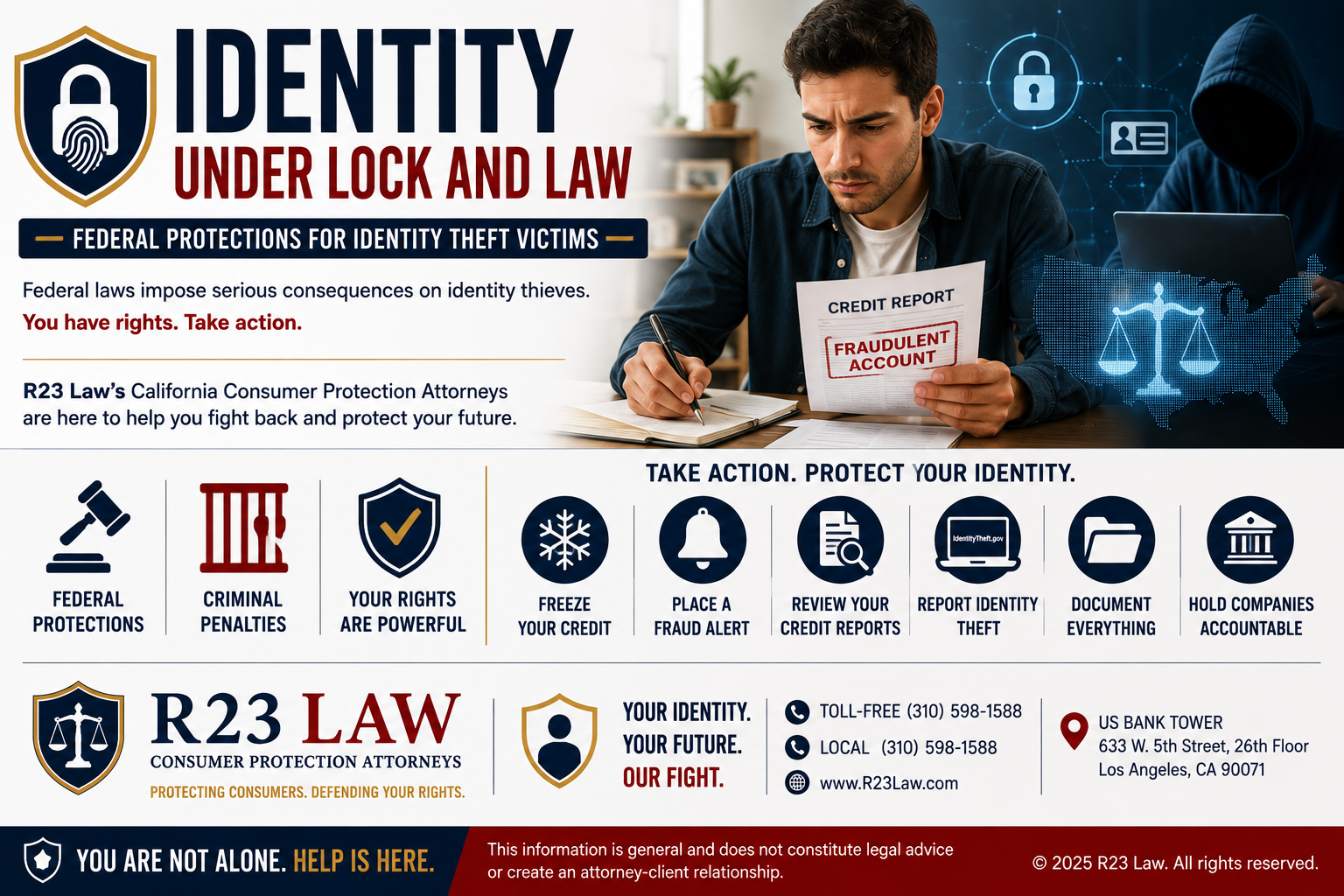
Identity theft can begin with one stolen number and quickly spiral into unfamiliar accounts, fraudulent charges, damaged credit, and lost financial opportunities
Fortunately, federal identity theft laws impose serious consequences on individuals who misuse another person’s personal information. These laws can apply when someone steals or uses a name, Social Security number, date of birth, credit card information, or other identifying data to commit fraud or another crime.
Victims should also act quickly to secure their credit, document the fraud, and preserve their consumer rights. R23 Law’s California Consumer Protection Attorneys represent consumers facing identity theft, fraudulent accounts, credit reporting errors, and related financial harm.
The Identity Theft And Assumption Deterrence Act Put Identity Theft On The Federal Map
Congress enacted the Identity Theft and Assumption Deterrence Act of 1998 as identity-related fraud became increasingly widespread.
The Act amended 18 U.S.C. § 1028 and made it a federal offense, under qualifying circumstances, to knowingly transfer, possess, or use another person’s means of identification without lawful authority in connection with unlawful activity. The statute applies to conduct involving federal offenses as well as certain felonies under state or local law.
Personal identifying information can include:
Names and dates of birth
社会保障号码
Driver’s license or identification numbers
Credit card and bank account information
Other identifying numbers or personal data
The law marked an important shift in federal policy. Identity theft was no longer treated merely as a side effect of another fraud scheme. The unauthorized use of another person’s identity became a federal crime in its own right.
The Identity Theft Penalty Enhancement Act Added Extra Time
Congress strengthened federal identity theft laws again through the Identity Theft Penalty Enhancement Act of 2004.
That law created the federal offense of aggravated identity theft, now codified at 18 U.S.C. § 1028A. A person who knowingly transfers, possesses, or uses another individual’s identity without lawful authority during and in relation to certain qualifying felonies may receive an additional two-year prison sentence.
For qualifying terrorism-related offenses, the additional sentence may increase to five years. These penalties are imposed in addition to punishment for the underlying crime.
Aggravated identity theft may arise alongside offenses involving:
Bank or wire fraud
Credit card fraud
Government benefit fraud
Tax-related fraud
Immigration document fraud
Other specifically listed federal felonies
The central message is clear: stealing someone’s identity to commit another serious offense can bring consequences beyond those attached to the underlying crime.
Criminal Penalties Do Not Automatically Repair A Victim’s Credit
Federal criminal laws focus primarily on prosecuting and punishing identity thieves. But an arrest or criminal conviction does not automatically remove fraudulent accounts, correct damaged credit reports, or reimburse every financial loss.
Identity theft victims may still need to challenge fraudulent transactions, dispute inaccurate credit reporting, and notify financial institutions that accounts were opened or used without authorization.
That makes immediate action essential. The sooner a victim creates a written record and secures affected accounts, the easier it may be to limit additional damage.
Freeze The Fraud Before It Spreads
A credit freeze restricts access to a consumer’s credit report, making it more difficult for an identity thief to open new credit accounts.
Consumers must contact all three nationwide credit bureaus—Equifax, Experian, and TransUnion—to place freezes on each credit file. Credit freezes are free, remain in place until lifted, and do not affect a consumer’s credit score.
A freeze does not erase existing fraudulent accounts or stop misuse of an account that is already open. It is a preventive measure designed to block additional credit from being issued in the victim’s name.
Place A Fraud Alert And Review Every Credit Report
A fraud alert instructs businesses to verify a consumer’s identity before opening new credit.
Unlike a credit freeze, an initial fraud alert can be placed by contacting only one of the three nationwide credit bureaus. That bureau must notify the other two. An initial fraud alert generally lasts one year and may be renewed.
Victims should also review their credit reports closely for:
Accounts they do not recognize
Incorrect addresses or employers
Unfamiliar credit inquiries
Fraudulent collection accounts
Incorrect balances or payment histories
Personal information belonging to another person
Every suspicious entry should be documented before a dispute is submitted.
Create An Official Identity Theft Record
IdentityTheft.gov is the federal government’s identity theft reporting and recovery resource. Consumers can use the site to create an FTC Identity Theft Report and receive a recovery plan based on the type of fraud involved.
An FTC Identity Theft Report may become important when disputing fraudulent accounts or requesting that identity-theft information be blocked from a credit report.
Victims should retain copies of:
The FTC Identity Theft Report
Police reports, when applicable
Credit reports showing fraudulent information
Bank and credit card statements
Dispute letters and delivery confirmations
Emails and letters from creditors
Notes from telephone conversations
Notices denying credit, housing, or employment
Documentation can establish when the fraud was discovered, which companies received notice, and whether those companies responded appropriately.
Financial Institutions And Credit Bureaus Must Take Consumer Rights Seriously
The identity thief may not be the only party whose conduct requires scrutiny.
A bank, creditor, merchant, debt collector, or credit reporting agency may create additional harm when it ignores a valid identity theft report, continues pursuing a fraudulent debt, or leaves inaccurate information on a consumer’s credit file.
Depending on the facts, this conduct may warrant review under federal or California consumer protection laws. A consumer may have legal options when a third party fails to properly investigate disputed information or continues treating the victim as responsible for identity-theft accounts.
R23 Law’s California Consumer Protection Attorneys can examine the entire chain of events, including:
The initial theft or misuse of identifying information
Fraudulent accounts and unauthorized transactions
Communications with banks and creditors
Credit bureau dispute investigations
Continued collection of identity-theft debts
Financial and emotional harm caused by unresolved fraud
R23 Law’s California Consumer Protection Attorneys Stand With Identity Theft Victims
Identity theft can disrupt far more than a credit score. It can interfere with housing, employment, financing, and a consumer’s sense of financial security.
R23 Law’s California Consumer Protection Attorneys represent consumers whose identities have been misused and whose disputes have not been treated fairly. Our team reviews the evidence, identifies potentially responsible companies, and pursues available remedies under applicable consumer protection laws.
Contact R23 Law’s California Consumer Protection Attorneys today for a free consultation.
Your identity belongs to you. The consequences should belong to those who misused it.
This article is provided for general informational purposes and does not constitute legal advice or create an attorney-client relationship.
